2015/03/18

Day eight: Timbuktu (March, 17)

Happy St. Patrick's Day (at least it was when I began writing this post).

I must say that there is a lot of irish beer in these lines, and precisely about a movie that I'm not sure what to truely think. 

Timbuktu is a beautiful picture, nominated to the Oscar of best foreign movie in 2015. The desert, the characters, the way that we are lead to enter a comunity infiltrated by jihadist rebels thought the life of its inhabitants. 

The growing knot in the throat in front of many injustices projected on the screen is a constant feeling during the movie. The invaders have no ears to the locals, and it is more noticeable by the babel that is installed in the town: arabic, french, english, Bambara, Songhay are the languages listed on the production's page on imdb. Homicide trials are manage through a rough translations. 

But it is the big picture, and the film bring us also the smaller ones, that are part of the everyday life: a man has to take out his pants because the lenght of it - the lawfull one is in the middle of the calf (what?). His pants refuse to stay put at this lenght, so he has to take it out and walk the streets in his underwear. Bureaucratic violence in its fullness, marked beautifully in the soccer game without a ball (a scene for life).

A violence that let the inabitants lost in the desert, running through sand in toward nobody knows what. A place where the craziest person is the one with more clarity (what is not a surprise actually) 

And in front of that, I spent the movie with my hands in my face, trying to deal with such injustice. 

But my concern, listed in the beggining of this post, is this: even in my extreme foreign politic's ignorance, I cannot conceal a nagging feeling that followed me during the screening that the film can be a bit simplist in some aspects, despite its beautiful and complex portrait of some characters. A concern that must be a product of the lack of knowledge about the subject. But I thought it was important to highlight this. Hoping that someone will take debate about with me in the comments box below...


Timbuktu. Directed by Abderrahmane Sissako. With: 
Ibrahim Ahmed, Toulou Kiki, Layla Walet Mohamed. 
Writers: Abderrahmane Sissako, Kessen Tall.  France/
Mauritania, 2014, 97 min. (more like the whole duration 
of the universe in its endless agony), Stereo, Color (Cinema). 


PS: Fragments: My week with Marilyn (2011); Silver Linings Playbook (2012); Jude (Christopher Eccleston in 1996!).

PPS: The (un)civilized world of movie theater's customers:


2015/03/16

Day seven: The Fault in Our Stars (March, 16)

Eight movies a week! Ops, nine, with today film in the One movie a day dare.

My TFIOS poster
I had some options for today, two movies at the theater, three at DVD... But when I came home, with a bit of a cold, tired, a little low, actually, I just wanted something familiar. Comfort food, loved movie. So, with some left over soup, hot bread and the known world of my sofa, I watched The Fault in Our Stars in cable tb. 

It was the ninth or tenth time, I'm not sure anymore. But it was just what I needed today.

Everytime I see this movie I remember a site at the time of its premiere where people got to swear at John Green for how said the story is. Fuck You, Jonh Green, was its moto. You read a book, you see a film, and it makes you cry and laugh and feel too much. So the natural result is blame the author. Nothing fairer.

What is not fair is that two lovely teens had to endure such a hard life. I know, this happens. Shit happens to everybody, in different aspects and intensity. It hurts, and there's no thermometer to measure any kind of pain. However, in this love story between two sick teen, the unfairness is what overwhelms me every time. 

I cry in different parts in each of the times I see it - however, it's sure that I'll cry at the swing set scene every time. Today, it was specially intense in the lovemaking scene. What was supposed to make me happier, let me down hard. And, again, I thought that the lack of fairness is what makes me so sad. The lack of time to live what it could have been a fulfilling life.

One point I want to highlight today. At the time the movie was released, some critics said that the Gus' character is not credible, not real. He would be too nice, too funny, too shallow, not deep enough . And despite the fact that the movie lessens some of his depth, Gus is still a strong character for me. At some point, he says that he endured a year of torture and the loss of his leg. I think that a person, specially a young one, that got throught such a dificult period in his life, learns there is another way to react to things and be with people. And I think Gus is like a compendium of this matter. And in being like this, he is admirable, not weak or silly.

I've been talking about this story for so long now that everything that I write in here sounds old to  me. Yet is still important to say how good an adaptation this movie is, with great and honest authors, a good direction and a cool soundtrack (except the Ed Sheeran song and that one about angels, both awful, sorry), even if there are many aspects that are not well sustained in the movie as in the book - what is usual in adaptations. The main aspect is that the story is there, and so are the carachters, and it is much of an achievement in adapting a book to the cinema. 

Another thing that I love in TFIOS is how it emphasises how fiction is a part of our lives. Surrounded by people that love her, the protagonist, Hazel Grace, finds understanding in a book. Nothing is able to relate to her and what she endures in the cancer treatments as a book called An Imperial Affliction. What is sintomatic is that TFIOS is important to some many people for the same reason. And the reader can relate to that. I did, despite being an adult in front of a young adults book/movie. It could understand me in ways that some of my closest friends are not able to do every time that life gets so hard (and I have amazing friends!). That is the beauty of fiction, whatever its medium: it seems so distant of real life, but it is ingrained in reality. In more ways that we are aware of. 


The Fault in Our Stars. Directed by Josh Boone. With: Shailene Woodley, Ansel Elgort, Nat Wolff, Laura Dern. Writer: Scott Neustadter and Mchael H. Weber from the book by John Green. US, 2014, 126 min., Dolby/Dolby Digital/SDDS/Datasat, Color (Cable TV). 


PS: At 2013, in a teaching internship, I proposed to adapt a scene from a book to a video, in an exercise of experiencing differentes ways of telling a story in order to understand how strongly fiction is a way to build subjectivity. The experience was great, the video is pretty good for starters, but I'm not allowed to show it here. Instead, I'll attach to this post two videos from youtube that inspired me to create the experience in class with the students, before the TFIOS movie was even produced. The first one is a great adaptation of this part on the book, better than the movie actually (there is a deleted scene in the extended version that make up for this fault in the film).


PPS: Behind the scene videos:


PPPS: Fragments: Nebraska, 2013 (How I love this movie...); Stranded in Paradise (a silly tv production) and Thor: The Dark World (I didn't disconnect myself from Tom Hiddleston's Adam yet, even if Loki is really great...).

Day six: Only Lovers Left Alive (March, 15)

"Flesh blood, baby!"

In this cruel, unfair, cold world there are so few certainties. Love. Compassion. Friendship. Honesty. Art. Or, in a better thinking, there is no certainties at all. Howsoever, some individuals bring those (no)certainties with themselves. Jim Jarmusch is, no question, one of them.

Among so many images, songs, stories, forgetfulness is usual. But I question myself how I can forget some things.  Only Lovers Left Alive is one of these things, and a picture of the movie in the internet reminded me, at saturday, of what I shouldn't have forgotten: a vampire love story directed by the amazing Jim Jarmusch.

So, I was chosen again by a movie, and Only Lovers was with me in this challenge. After seeing it last night, I turned off the TV, went to bed, read the final pages of the last Murakami's book, The Colorless Tsukuru Tazaki and his years of pilgrimage  and sought oblivion in what would hopefully be crazy dreams. Because, if I had decided to write about this movie right away, this post would be nothing but sighs. Profoundly happy sighs of joy and extasis.

Not that it is so different the way it is now, a day latter. 

I have to say more? Ok. Carved by hand are the scenes, as a fine sculpture. Tilda Swinton and Tom Hiddleston are a true vampire couple - there are not another explanations for their perfection on these roles. The story doesn't take itself so seriously, and is deathly serious just for that. The humour is sharp. Its fierce commitment to love. Mia Wasikowska (hello again!) and John Hurt are also vamps. The art direction is pure joy. Music and books are what make these characters... So, as I've said, extasis.

I've spent all sunday in a bubble of anxiety - I had decided to watch the movie at night, of course, and I hardly could wait to see it. I poured a pint of Guinness (Sorry, Jim, those two brithish actors are the priority), turned off all the lights in the house, silenced my phone, and put my heart in soul in front of the screen. And except for the last scene (there is always a but), I thought it was a very wise settling for a F@*$(##**% amazing movie.

The swearing above is not in vain, I promise you, my friend. 


Only Lovers Left Alive. Directed by Jim Jarmusch. With: Tilda Swinton, Tom Hiddleston, John Hurt, Mia Wasikowska. Writer: Jim Jarmusch (of course). US/Germany/Greece/Cyprpus, 2013, 123 min., SDDS/DTS/Dolby Digital, Color (DVD). 


PS: I don't know how that happenned, but I put Jim Jarmuch's Dawn by Law (1986) competing with Steve Soderbergh's Sex, Lies and Videotapes (1989) at Cannes. It wasn't like that, how I could confirm now in the resourceful  internet. But both directors, with these two movies in particular, got my attentions at the same time - at least in my head. From that moment, I always was aware of their movies. Soderbergh lost a bit of my interest in some aspects, but I still enjoy his films. This post scriptum, though, is mainly to thank Jarmusch for introducing me to Screamin'Jay Hawkins, in this scene from Stranger than Paradise (1984):


PPS: To be fair, "This is not a taxi, I promise you, my friend" is in my mind because of Michael Cera in the too cute for one's health Nick and Norah's Infinite Playlist (2008). 

2015/03/14

Day five: Kingsman: The Secret Service + Focus (March, 14)

In honor of Pie Day, a nerd movie. It wasn't intentional, but, how I said before, I don't choose the films... It seems to choose me instead.

Eyes on the screen, I couldn't believe in what I was seeing. So many references, so ironic, so much fun... I haven't read the comics (I will now), but I'm sure Kingsman: The Secret Service is a nice adaptation. For a start, the director, Mattew Vaughn, was a co-creator of the characters, along with Mark Millar and Dave Gibbons. Researching about the comics and the movie, I found a 2012 article that announced the comics and the possibility of a movie. I didn't know about that until five minutes ago... And my question is: where do I live? In Mars? And I even say that I like comic books... unforgivable. 

The movie is fun, fun, fun... My smile was bigger and bigger at each scene... untill the church part, when it becomes a violent vision of the world. But I shouldn't have expected less from Vaughn. We laugh, but we don't do it in vain: Kingsman is a very serious business, even if it is also a funny and smart one. 

Colin Firth is always a gift, specially when we don't see him in the screen so frequently. His character brings so many references, the most precious to the british, as it seems, that I just wish I'd be smarter to get all of them - one example is his room with The Sun's first pages... so many irony there, I'm sure. But the majority just pass in blank by me. What a shame. 

My eyes, my mind, my soul were happy today. And right now I just want to see it again, regretting that I didn't go to a screening in the xD theater last week. It must have been amazing watching it in the giant screen. 

An observation: I'm more and more averse to people in movie theaters. For that reason, I see myself seeking the front seats more often. The problem is, lots of people now do the same. And they all must have a sense of solitude so strong that makes them buy a seat too close to others. Sorry, this is my stake in being a little crazy (a prerogative due to every human being). But in a time when the customers think they are in their living room watching tv, it is difficult to be around them. Today a couple seated clumsily behind my chair, with the guy putting his bare feet in the chair near me right away. A very ugly feet, I must say. I changed places to got far from that gross thing and I watched happily a very good movie. In peace (ok, maybe I'm a little crabby today... but that feet was really too much to a person that already lost her faith in movie theater's customers). 

Kingsman: The Secret Service. Directed by Mattew Vaughn. With: Colin Firth, Taron Egerton, Mark Strong, Samuel L. Jackson, Michael Caine. Writers: Mattew Vaughn and Jane Goldman from the comic book by Marak Millar and Dave Gibbons. Uk, 2014, 129 min., Dolby/Dolby Atmos, color (Cinema).


I'm aware that this blog is called One Movie a Day... but sometimes this number is multiplied. I love double and even triple movie's ehxibitions. And this saturday wasn't any different. After Kingsman, I saw the door to the other theater openned and decided for a double feature. 


It was not really fair to watch Focus near Kingsman. The difference between both is bigger when they're close, more than it would be, I think, if I'd saw the two films separately. Course, it is enjoyable, witty, but all the time I thought how Out of Sight (1998) is so much better. Again, I wasn't being fair, maybe, but during the movie I got this persistent idea that Focus was reaching to be what the movie by Steven Soderbergh with George Clooney and Jennifer Lopez is: a smart and charming con man as a hero, the image and sound out of sync in some scenes, smart songs... At the end, nothing was different in me, except what I thought while seeing Kingsman. But it was fun, Rodrigo Santoro has more than two lines and it was also a good way of staying out of home in cleaning day. 

Focus. Directed by Glenn Fiquarra, John Requa. With: Will Smith, Margot Robbie, Rodrigo Santoro. Writers: Glenn Fiquarra, John Requa. US, 2014, 105 min,. Dolby Digital/Datasat, color (Cinema).


PS: Fragments: The Fautl in Our Stars was with me while I was writing this post. Good thing that, the first time, I didn't cry my eyes out when with this story...Ok, too late now. Already crying (The eulogy scene... understandable, right? Better to end this post now).


2015/03/13

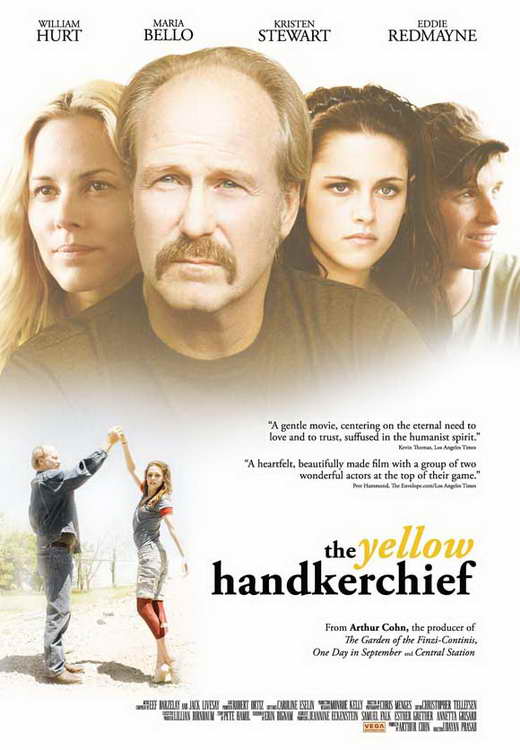
Day four: The Yellow Handkerchief (March, 13)

At this moment I realized today is Friday 13. I should had chosen a horror movie for day four... But I try to let the movie kind of choosing me. And that is what happened today. 

Last week, I was talking to some friends about the Oscars and at some point, I don't know why, we were talking about actors with weird faces. Benedict Cumberbatch was, of course, the first one. The other was Eddie Redmayne. The boys felt the same, but some of the girls disagreed with me, they thought it was disrespectful (it really wasn't).  
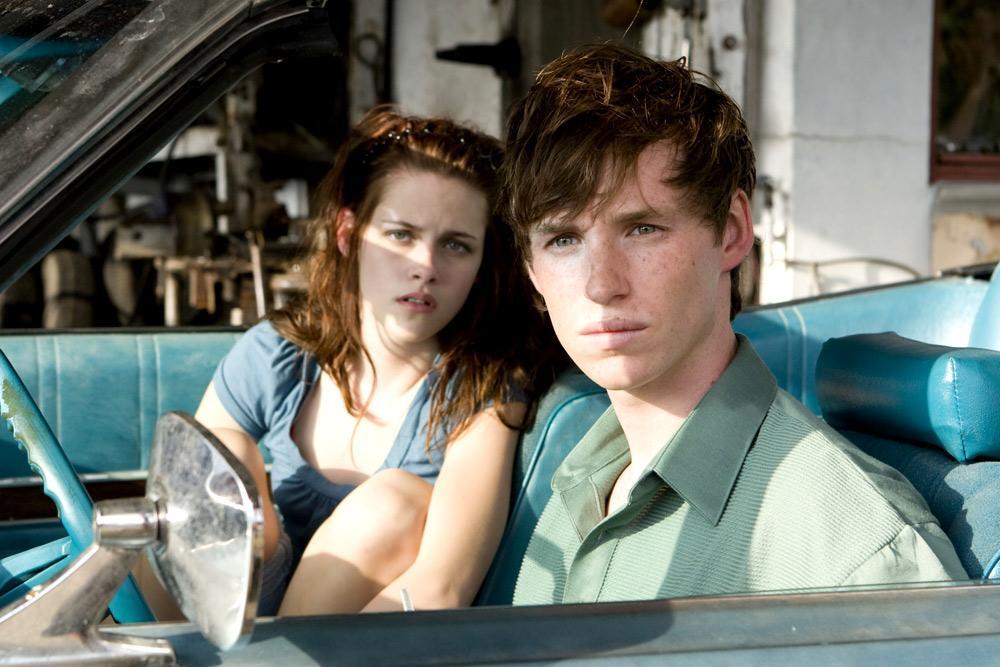
Today, I was abble to confirm how weird his face is in The Yellow Handkerchief, a 2008 movie directed by Udayan Prasad. I have wanted to see this film for a while, and yesterday, in Still Alice, it came to my mind again. And so he invited itself to One Movie a Day. 

Slow friday, quiet movie. At the beggining, I had the impression that it was a bit chichéd. Three lost people get together by chance and, in a road trip, start to know each other's life betterA behind the strangeness of each one. The ex-con, the rebel teen girl, the weird guy: the three see themselves travelling unwittingly throught the south of US in the same car. During the trip, their strangeness diminish with our own, as we can get a better sense of these characters at the same time that they know each other's motivations better. All of this in a gentle pace, with a lot of yellowed flashbacks.

I like movies about lost people, so much that I'm not even aware of that. But, in this film, I remembered the first time I consciously realized that feature. Nocturne Indien, a french production by Alain Corneau (1989), called my attention to how atractive to me are stories about being lost. I don't remember it in details, just this realization. That was what stayed with me until today.

William Hurt is so right playing a sad, lost man. His name is not for nothing, as it seems. Kristen Stewart, still shrugging, is beautiful and also sad as the lost teen that travels by car with two strangers. And Eddie Redmeyne is a delight, in his weird, inadequate boy that hides his sadness in a silly facade. I could see that, despite the fact that I can only find him too cute after his best actor's acceptance speech at the 2015 Oscars. I found myself smiling in many moments because of that. And, at last, Maria Bello, in a strong even if smaller presence in the screen.

But my smile was also related to the story and the characters, that grew in me during the film. Beautiful scenery mixed with abandoned houses and the almost claustrophobic feeling that the south has on me, the folk songs, a quiet pace and soon we are captured by the story and the people in it.

A good journey in a really quiet day. 

The Yellow Handkerchief. Directed by Ydayan Prasad. With: William Hurt, Maria Bello, Kristen Stewart, Eddie Redmayne. Writer: Erin Dignam from a story by Pete Hamill. US, 2008,  102 min, Dolby Digital/DTS/SDDS, color (DVD).


Ps: This first post scriptum is about, of course, the cutest acceptance speech in the history of the whole universe:

PPS: Fragments along the day - during breakfast, crocheting and such:  Remember Sunday (2013), a cute movie, The Place Beyond The Pines (2012), a heartbreaking one, and Rush (2013).

2015/03/12

Day three: Still Alice (March, 12)

Today, something that happened to me at the movies years ago came to my mind. I had just watched A Beautiful Mind (2001) and I couldn't leave my chair. I was seated at the last roll, in a corner, and wasn't able to stop crying. It was so bad that the cleaning crew probably cogitated to call a mad house to take me. They left the room and I was still there, crying. When I got home, I emailed Professor John Nash telling how his story had a strong effect in me. Maybe he also pondered about the mad house for me.


At the end of Still Alice,  by Richard Glatzer, the feeling was very similar to the one in 2001. I had a knot in my throat and in my heart. I hid my face in my jacket and fat tears insisted in go down, even if I was very conscious of the people around me. For a start, I went to the screening with a friend, and despite being an old and good friend, I thought weird crying like that in front of her. So I stopped, got up at the end of the credits and put on a brave face. But all afternoon I was mourning, like Alice was a close friend and I just testify the loosing of her mind for Alzheimer's.

This proximity with a story and its characters is not a novelty for me. I always felt this way in the movies. For some time, it was not unusual that some friend, near me in a theater, looked straight at my tearful face and said: why are you like this? It is just a movie!!!! But for a time now I hadn't heard this exclamation - my friends must have adapted themselves to the strange way that I relate to films. 

And the truth is that cinema for me is life. Fiction can tell about aspects of real life in a way that facts are not able to. And today I thought how stories that depict people struggling with the loss of control of their own mind sensibilize me a lot. 

Julianne Moore won a best actress Oscar for her role in Still Alice. For that, the movie's plot is well known, so I'll talk about the story a little bit - it is not a big spoiler after all. Alice is a renowed linguistic professor at Columbia University (my dream university, by the way). She relies in her knowledge, in the capacity of her mind, in her memory. After all, she is a specialist in cognitive science. Until the day she sees herself loosing this capacity. Her diagnostic of Alzheimer's is a sentence of death in all her beliefs, and the movie transits around her dealing with the disease and her family's reactions. What they can or cannot accept. What it is acceptable to her. The increasing of the disease. The different aspects of dealing with a illness is there, and, at some point, she says that she is not Alzheimer's, and persists of not loosing herself.

But it is inevitable. All the knowledge, all her habilities, all the love of her family can't detain the desease's advance. And we testify Alice loosing herself more and more. 

I'm not a believer of full control of life. And I don't scare easily in front of adversities and illness. Of couse I suffer with the unpredictable. Of course I struggle when I'm sick. But I know how we are really not able to control everything, or anything actually, in our lives except how we choose to face it - in its adversity, happiness, unpredictability and so. But see someone loosing such a battle is heartbreaking for me. And so I spent all afternoon with a sad heart whilie doing my grocery shopping. Such a strong feeling in a casual task. 

Julianne Moore is great. Her Alice becomes a real person in her interpretation. Kirsten Stewart could use a better direction, her tic of sighing and trembling is still there - it was absent, though, in her performance in Clouds of Sils Maria, 2014(and maybe just for that amazing feature she won a César... Don't get me wrong, I like her, but this tic is too much sometimes). I was angry with the selfish husband played by Alec Baldwing, more when my friend told me that his character in the book is very supportive. Why screen writers see the need for changing the personality of the people in the stories they adapt to the cinema is always a mistery to me. 

All this talk was made to take your attention of my over the top reaction to the movie. But it is still with me, and probably it will be for a while. Like not only the good stories can be, but also those who tell us about things that we even realized yet.


Still Alice. Directed by Richard Glatzer, Wash Westmoreland. Stars: Juliane Moore, Kirsten Stewart, Alec Baldwin. Writer: Richard Glatzer from the novel by Lisa Genova. US/France, 2014, 101 min., Dolby Digital, color (Cinema).


PS: Fragments: a bit of my sadness vanished when I met High Fidelity on cable tv. I love Nick Hornby's books, and this one in particular. And its soundtrack is always a good remembrance. 

Day two: Ida + The Double (March, 11)

Day two  had two films in it (no pun intended). Both at the theater and both disturbing in its own ways. 

I'll invert the order and I will start with the second one. Ida, a poland production directed by Pawel Pawlikowski in 2013, won the Oscar for foreign movie this year. I was lucky, because I had missed it at the theaters and really didn't wanted to see a movie with what seemed to be an amazing cinematography in home, in my too small tv. 


Again, I didn't know a lot about the movie. I avoid reading critics and other comentaries about a film before going to the movies, trying to let it surprise me. Sometimes it is inevitable, especially in blockbusters' productions, and I must say that I'm not allergic to spoilers. But a filme that develps itself in front of you is always a nice experience. 

And Ida was a surprise that I hadn't had for a while. First, the silence. And how beautiful and strong it was. So eloquent, as it uses to be in movies that choose this way to tell a story, especially one about a violence so vile that any big noise is redundant. 

The three protagonists are very strongly depicted throught silence and the whiteness of the perfect cinematography. Big plans, small details, the piercieng eyes of Ida... all of it to give us an idea of how excruciating is the experience of war.That is, by the way, one of the characters in the movie. The other two, Ida herself and her aunt Wanda (both incredibly interpreted by amazing actresses) transit in the world of loss and profound pain in a way that penetrates in our heart in each take.

While I was buying the ticket to the movie, the girl that was selling it how she had enjoyed Kingsman, the third filme that I had planned for the day, but decided to dicht after seeing Ida and leaving the theater in a very introspective state. I asked her about Ida, and she told me that, ok, the story was good, but the silence, oh the silence, it was excrutianting. And unberable. And the scenes were too slow, according to her. So I smiled bit to her and said how I would like the movie for sure. During the movie, I thought how, despite (sorry) my increasing need to pee, I couldn't leave the theater for my life. 

I more than liked it. For some movies, I say that like is such an inapropriate  word. I felt that when I saw The White Ribbon, by Michael Haneke (2009). The movie is so accurate, so big in what it say, and so crude in doing it that has no way to say that we like it. Sure, Ida leaves a lot of space for enchantment, but the place that it put us in is so painful and sad that, if not for the extreme poetic images, it wouldn't be possible to see it. And, at the same time, it is what turns it so unbearable to watch.

Thats the point of poetry: an intensity so strong that can tell about love, hurt, lost in a way that nothing is complete or completely sure. It is ambivalent, cruel, overwhelming and, at last, hopeful. 

Rogerio Luz, a brazilian researcher, wrote that the cinema can bring to us the excrutiating experience of violence in a way that we couldn't live, fortunately, out of the theater. He exemplifies his idea with the World War II movies and the holocaust, that we can experience through many movies from different nacionalities. While watching Ida, his words came to me in many scenes (Filme e Subjetividade, Contra Capa editora, 2003). 

Another reference that became vivid during the ehxibition was the novel Hope: a tragedy: A novel, by Shalom Auslander. The author, through his main character and his unusual encounter with an old Anne Frank, discuss how the images of holocaust inhabit our imaginary today. It is a very dark humoured view, but an important one, attentive to the risks of how images can perpetuate things that are no longer like that  and can, in fact, diminish the violence of the holocaust. Ida encountered this thought in me in the painfull journey of the main character with her strongly pained aunt. 

But I talked more than I intended to, hoping that I didn't let out too much of the story. When you see it, or if you already had, let me now what are your thoughts about the movie. 

As an afterthought, Agata Trzebuchowska's eyes are realy the soul of the movie. And could be the protagonist of a horror movie anytime.

Ida. Directed by Pawel Pawlikowski. Stars: Agata Trzebuchowska, 
Agata Kuleza, Dawid Ogrodnik. Writers: Pawel Pawlikowski, Rebecca Lenkiewicz.Poland/Denmark/France/Uk, 2013, 82 min, Dolby digital, black and white (it was curious how almost all the credts was composed by Agatas or Marreks. Just a curiosity) (Cinema).


The first movie of day two was The Double, by british diretor Richard Ayoade, based on the book by Fiodor Dostoyevsky. In my perpetual ignorance, I didn't know that, and I thought Kafka all the time. 

Closed, dirty spaces... leaking ceilings, defective bulbs, eternal night. The claustrophobic feeling of being trapped, ignored and unknowledged by the people and the intitutions are there. Jesse Eisenberg is magistral in his performance, as the rest of the cast. So much that my constant feeling was of being traped myself. The movies' images kept enclosing me and all that I wanted was for that to end.

A strong sentiment was of dejà vu. I've already felt this way in a movie theater, though not for a long time. And the other perception was one of a vivid anachronism. This film, for me, belongs to another time, late eighties, mid nineties maybe. 

Asking myself of why was that, I reached the conclusion, that I'm not sure of, that today the problem is not to be heard by the people around us or even the big institutions, as the government. I hear numerous and loud voices everyday, so deafening in its erratic manners. The capable and correct good guy that is not heard, seen or acknowledged by anyone is not a figure that I see these days in the world. Of course, inadequation, invisibility, the seek of our own identity is here, as always, but not in the way depicted by The Double. And so, what remained from the movie to me was the disconfort, the claustrophobic feeling and the admiration for Eisenberg, a really good actor (with amazing cheeks).  


The Double. Directed by Richard Ayoade. Stars: Jesse Eisenberg, Mia Wasiowska, Walace Shawn (always the Vizzini). Writer: Richard Ayode, from the book by Fyodor Dostoyevsky. UK, 2013, 93 min., Dolby Digital, color (Cinema).


PS: Fragments: Today, having breakfast in front of the TV, as I do every morning, I saw a scene from Notting Hill, 2009, that I like a lot and made love the song in it. So I thought it would be nice to present you with this remembrance. 


PPS: The Double made remember a story by Milan Kundera in which a guy goes to prison for not being able to say no or speak his mind at work. But the name of the tale is a mistery to me.